

André Ethier
“....the paint is doing what it does and I’m doing what I do, and we work together. It’s a sustainable relationship."
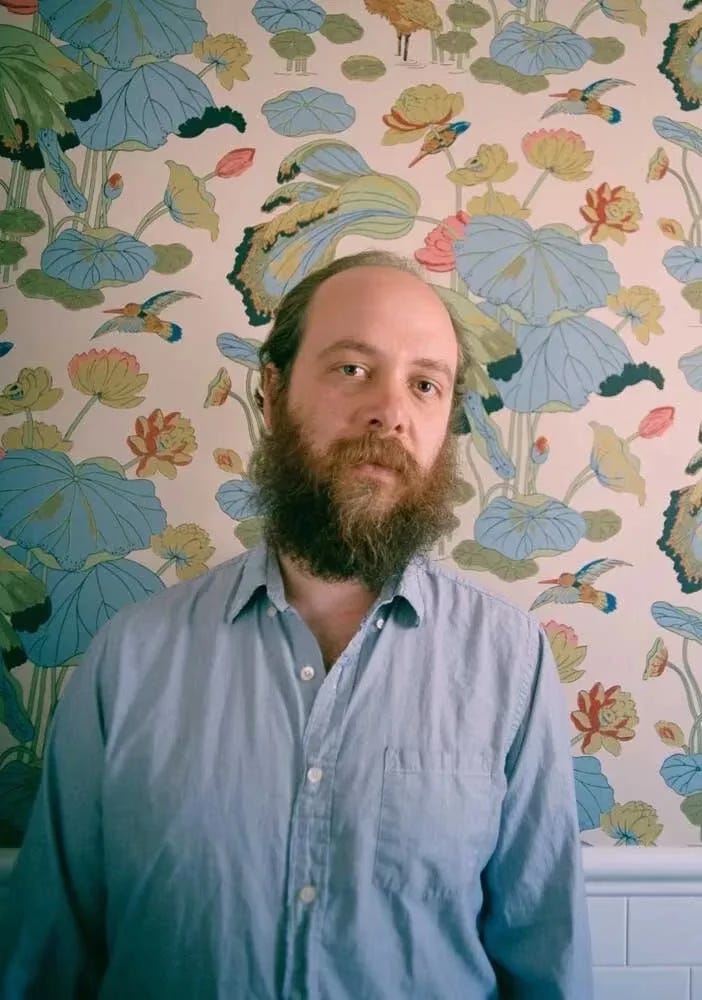
Born in 1977, André Ethier lives and works in Toronto, Canada. He received his Bachelor of Fine Arts from Concordia University in Montreal in 2001.
Ethier has presented numerous solo exhibitions internationally. Recent exhibitions include: André Ethier: Canned Heat at Derek Eller Gallery, New York (2025); What Isn’t Nature? at Paul Petro Contemporary Art, Toronto and Thoughtful Paintings at Derek Eller Gallery, New York (both 2021); Interior, Bedroom, Day at Paul Petro Contemporary Art, Toronto (2018); and André Ethier at Harper’s Apartment, New York (2016). Earlier solo presentations include exhibitions at Honor Fraser, Los Angeles; Greener Pastures Contemporary Art, Toronto; Galeria Marta Cervera, Madrid; Galeria Glance, Torino; Skew Gallery, Calgary; and Luft Gallery, Toronto.
His work has also been featured in group exhibitions in venues across North America, Europe, and Asia, including: Derek Eller Gallery, New York; Clint Roenisch Gallery, Toronto); the Frist Center for the Visual Arts, Nashville; James Cohan Gallery, Shanghai; the Museum of Contemporary Canadian Art, Toronto; the Museum of Comic and Cartoon Art, New York; Royal/T in Culver City, Daniel Weinberg Gallery, Los Angeles; Galerie Bertrand & Gruner, Geneva; and Gallerie Anne de Villepoix, Paris, among many others.
Ethier’s work and exhibitions have been reviewed and discussed widely in publications including Frieze, Artforum, Art in America, Border Crossings, Canadian Art, The New York Times, The New Yorker, Los Angeles Times, and Chelsea Clinton News. Critics such as Roberta Smith, Christopher Bedford, Robert Enright, and Holly Myers have written about his distinctive, psychologically charged figurative painting practice, which blends expressive form with allegory and imagination.
MEPAINTSME: I first came across your paintings nearly 2o years ago and was immediately drawn to their heavily painted surfaces and weird imagery populated by trolls, Vikings, and curious plant and animal forms. What attracted you to those subjects at the time?
ANDRE ETHIER: Mmmm. I had just gotten out of Art School and had stopped painting completely for several months, when a friend of mine offered me some studio space. I had to decide then if I was going to continue to paint at all, but I took the space. I remember struggling with what to paint and how to paint. I didn’t feel connected to who I had been as a student or how I had been motivated before. Out of a lack of any new ideas, I suppose, I reverted to my first inspirations from primary school. I reconnected with an earlier self that doodled gnomes and elves in the margins of workbooks. It was probably a subject to entertain myself as I explored new ways of painting. The way it was going lent itself to beards and flesh and flowers and vines anyway. Although I had been to School, I was young and still ignorant and still curious of what a “painting” even was. I think I was trying to simply make “paintings” without being willing to look up from my own work. I think I was aware enough at that time to see some virtue in that. I don’t really care about Vikings and wizards in my day-to-day life now and didn’t really then either. I thought it was funny, I guess.
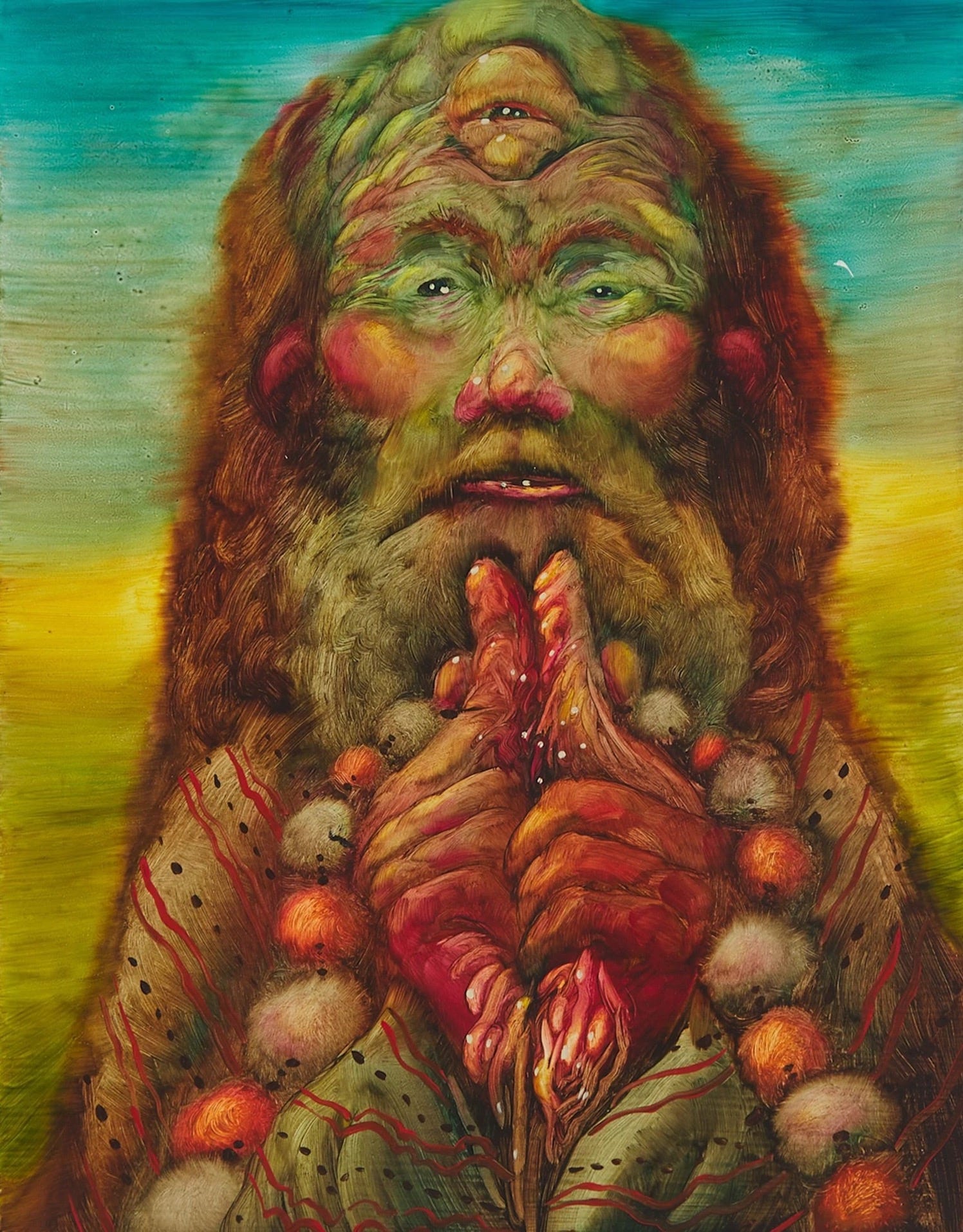
MPM: What also drew me to your work (and still does) was it felt deliberately oppositional—rejecting conceptual polish for the raw, messy, adolescent, in us all. Having been painting for so long, does this stance still hold meaning for you now?
AE: I only realized that the work was in anyway confrontational, or oppositional to what was happening in the galleries at the time, was when I first started showing. I could see that the context of the Gallery was activating a meaning in my paintings. I think some people found it challenging or amusing. I did want to remind people of their own adolescence and how close it was. How it was just under the surface of their adult sensibilities. I think most people got that. In my studio, I don’t really see my work as Art — they are paintings, or maybe just the results of a behaviour. They only become Art when jammed into the conversation of the Art world. It helped me then to think that way and it helps me now. I don’t want to be burdened with creating meaning. I’m fast and messy because I want to be and I know there is room for that out there. I’m not motivated by feelings of opposition. I’m innocent.
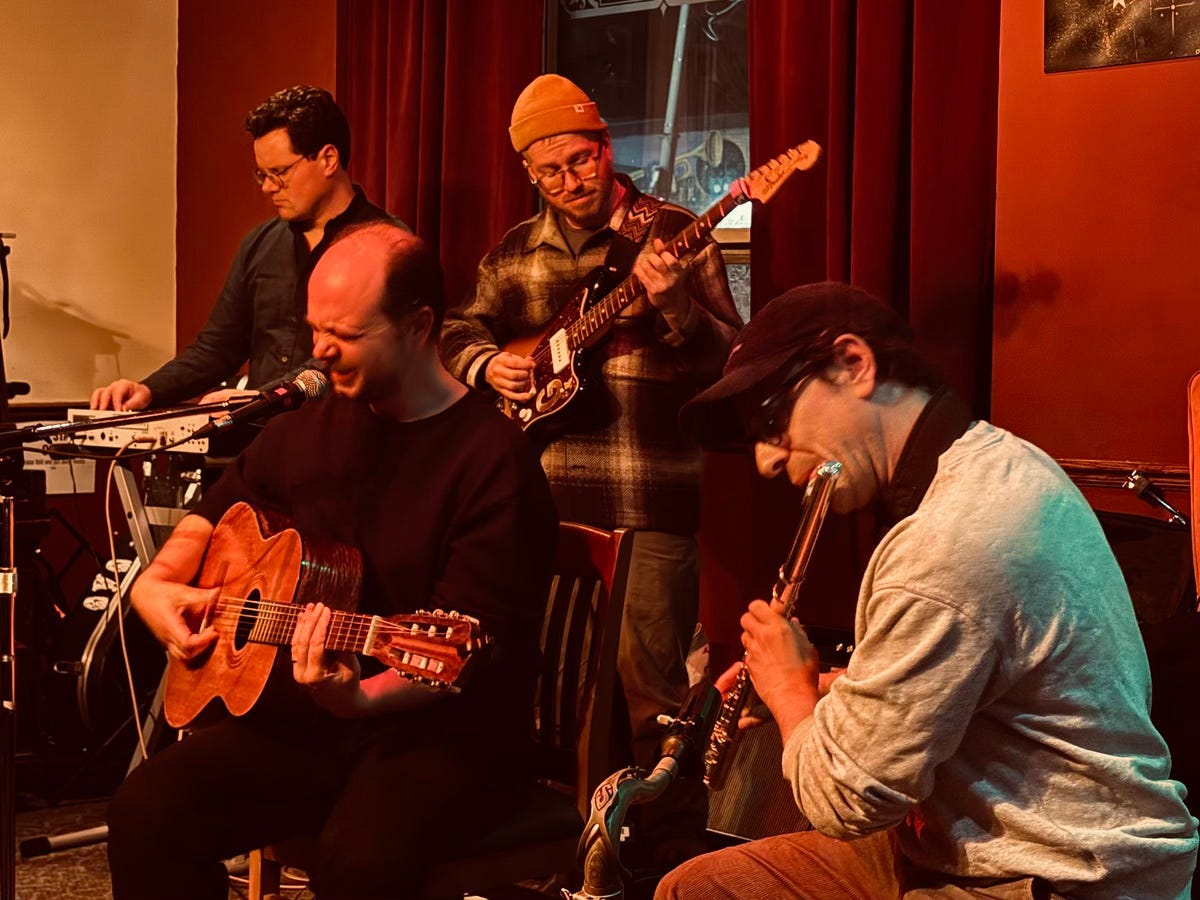
MPM: You’ve managed to build serious careers in both music and visual art, which few artists sustain successfully. Do those two practices feed each other, or do they require completely different parts of you? Do you see parallels between songwriting and painting?
AE: The two feed into each other these days. When I was in my 20’s I was in a band, and songwriting then seemed to come from a different part of my mind. I was more interested in genre, and lyrics and melody flowed more from trying to identify how to write towards what I thought the band was supposed to be. I felt some responsibility to the bands’ collective personality. Painting is more improvised and exploratory. I’ve found in the last ten or even twenty years, painting and songwriting have both come from mostly the same place. I find words in singing nonsense and melodies come from hearing myself singing. Songs are like paintings in that chords and melodies are like materials and colour, and lyrics are like subject matter. A difference is I try to complete a painting in one sitting and as quickly as I can, while an unfinished song may bump around in my head for months. A painting I’m more aggressively trying to catch, and a song I can wait forever for.
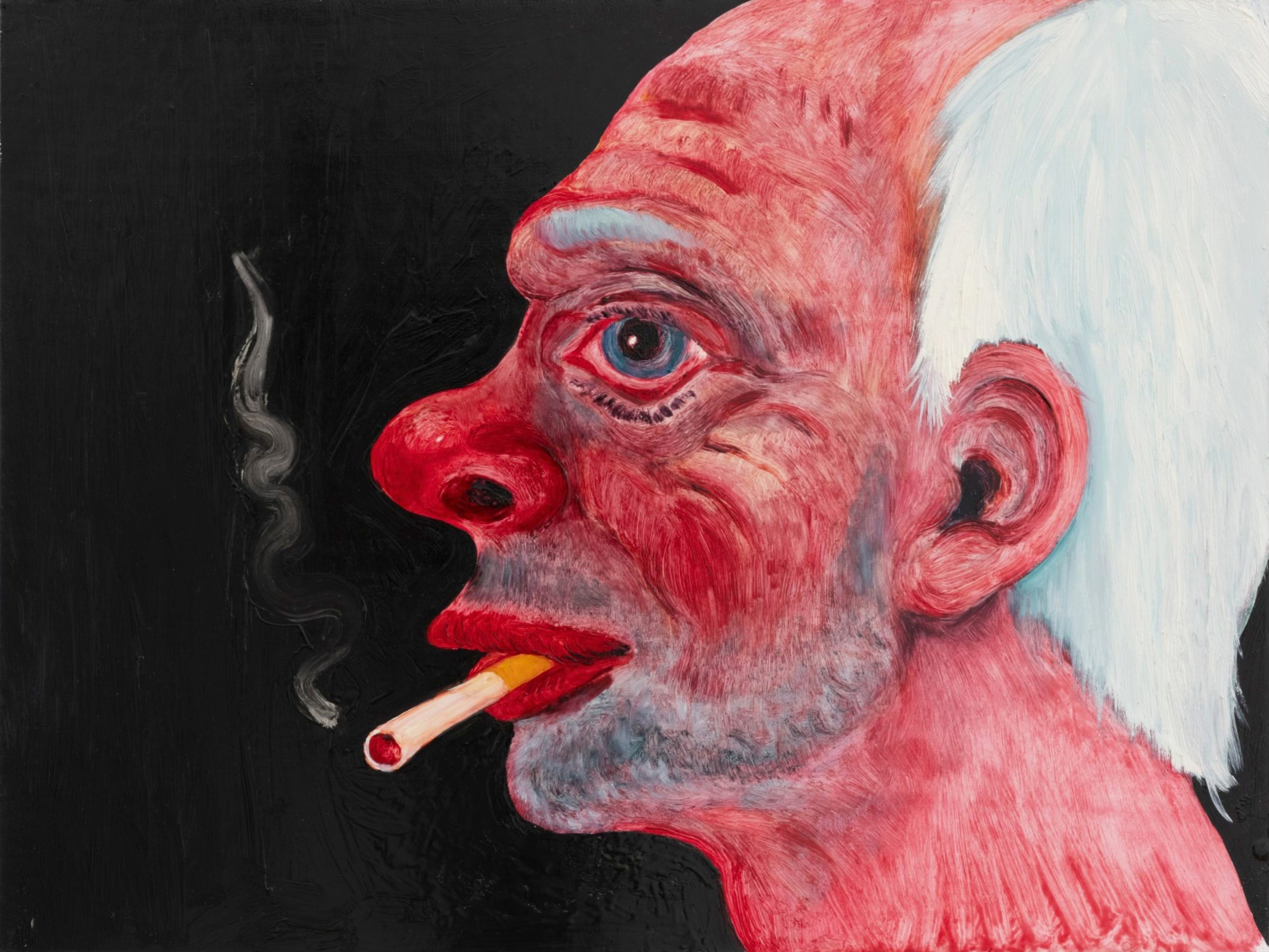
MPM: Those earlier works were deeply rooted in materiality—the honey-like viscosity of oil and stand oil created a balance between control and accident. Do chance and material still play as important a role in your current process?
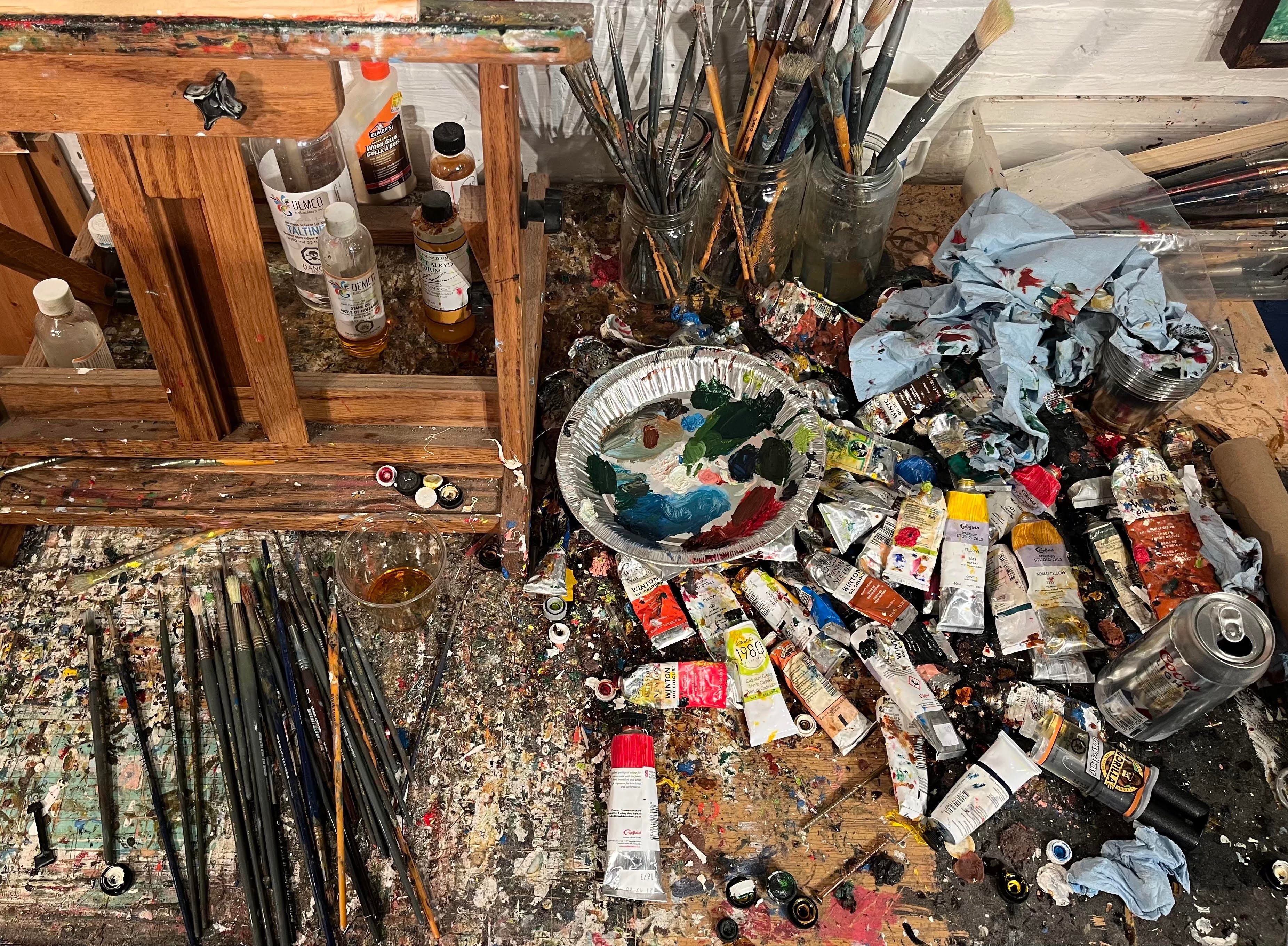
AE: Totally. Chance and Materiality are the prime movers. I use a lot of stand oil. The ratio is almost like working in watercolor and if I didn’t use drying agents the paint’s pigment would separate in the oil. I have to work faster than the painting is drying and even at three hours in, I can feel the paint start to change its properties. I’m working faster than I can think. Ideally, I would be painting first thing in the morning and be so wired on coffee that I don’t even realize I’ve started till I’m halfway through. I like mornings because I’m still close to dreaming. By evening my head is full of the day and I’m a very different person. Anyway, I like wet muddy paint, I like three dimensional surfaces, I like ridges of paint catching light, I don’t like dry and flat surfaces, and I don’t respect control. I think I have a relationship with paint that is sustainable, the paint is doing what it does and I’m doing what I do, and we work together. It’s a sustainable relationship.
MPM: Although your subject matter has certainly evolved over time, a certain dialogue between absurdity and the sincerity has remained. What connects those worlds for you?
AE: I try to be sincere. Painting as a behavior is absurd. You realize over time that you can’t learn anything really. Nothing really carries over from one painting to the next. You can’t will a painting to be good. You can’t research or prepare a painting into being good. It all just puts you in an absurd state of mind.
MPM: This could also be said of your use of color as both repellent and seductive—ranging from earthy tones to electric pastels. Are these types of contradictions important?
AE: I’m just not that concerned with colour harmony. I’m mixing colours on the painting not on the pallet. I’m reacting to thickness and thinness, brightness and opacity. I’m excited by wrongness and clumsiness sometimes, but other times I try to limit my pallet. I’ve certainly made paintings with too many colours. They begin to feel unsound. I try not to think about it, I can always reject them later. I’m forever impressed with other painters’ use of colour. The first step of any painting is squeezing paint onto your pallet. I’m not too discerning when I do this, I just grab a little of whatever. Maybe I’m exaggerating, I think about it a bit. I’ll paint an onion the colour of an Onion. Black solves a lot of issues. Black background as a compositional cheat.
MPM: What attracts you to small-scale painting, and what possibilities does it offer that large canvases might not?
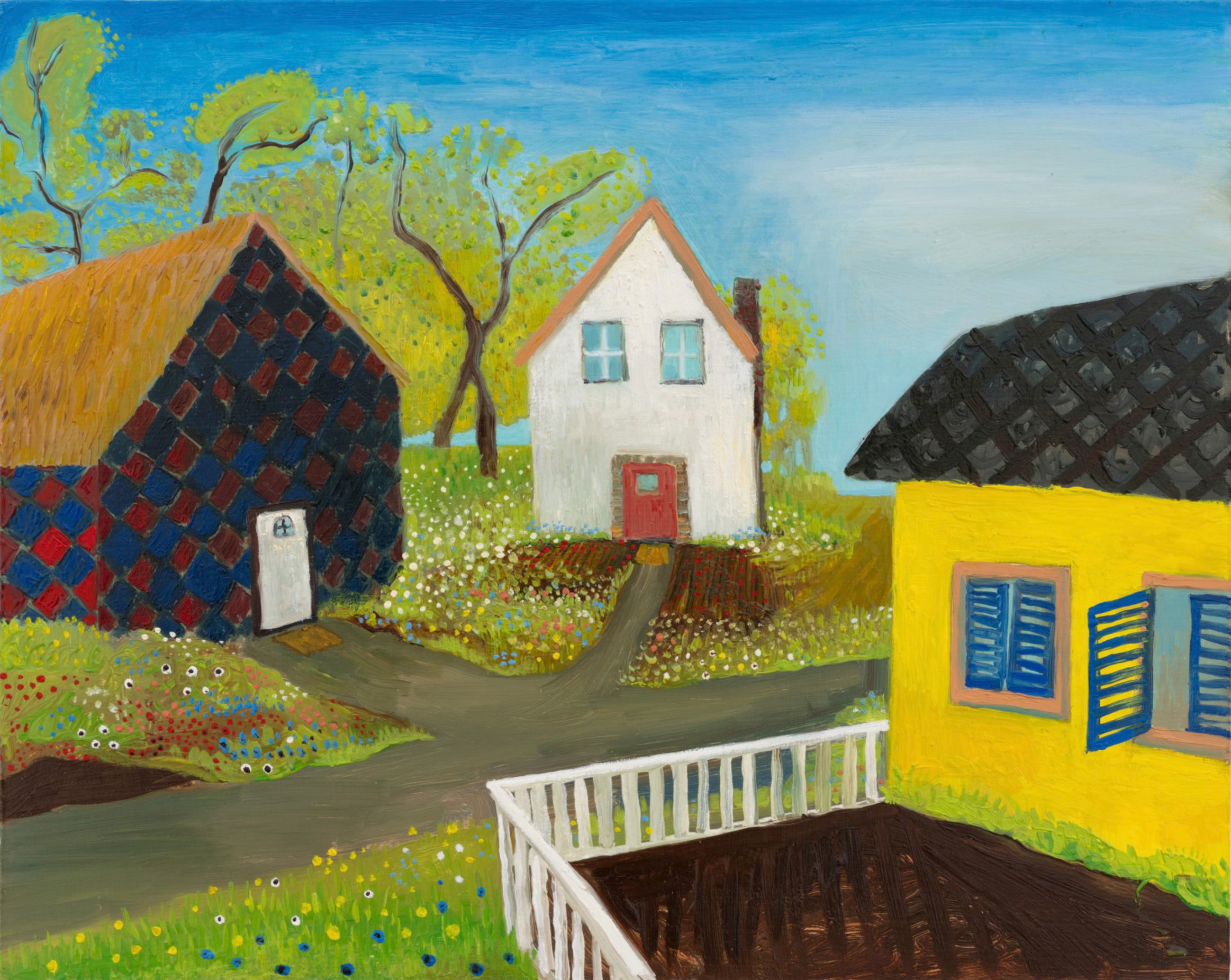
AE: I work on Masonite and the larger it gets the more it warps. I’ve tried to work on canvas, and I’ve tried to work larger, but I can’t find myself there. I think of the paintings I’ve done and imagine them larger, and I’m annoyed. I think the paintings would be irritating at a larger scale. Small is inviting to me, people can come close and experience them like I do. At the scale that they are now, I’ve never felt that they couldn’t hold a wall. Drying time is a factor too I guess, and I don’t like returning to a painting to continue working on it — I change too much from day to day. I produce more paintings by working small, and in a way, overtime, the whole thing becomes kind of large scale in scope and volume anyway.
MPM: Humor plays a role in your work, even when dealing with serious ideas. How important are those qualities to you as an artist?
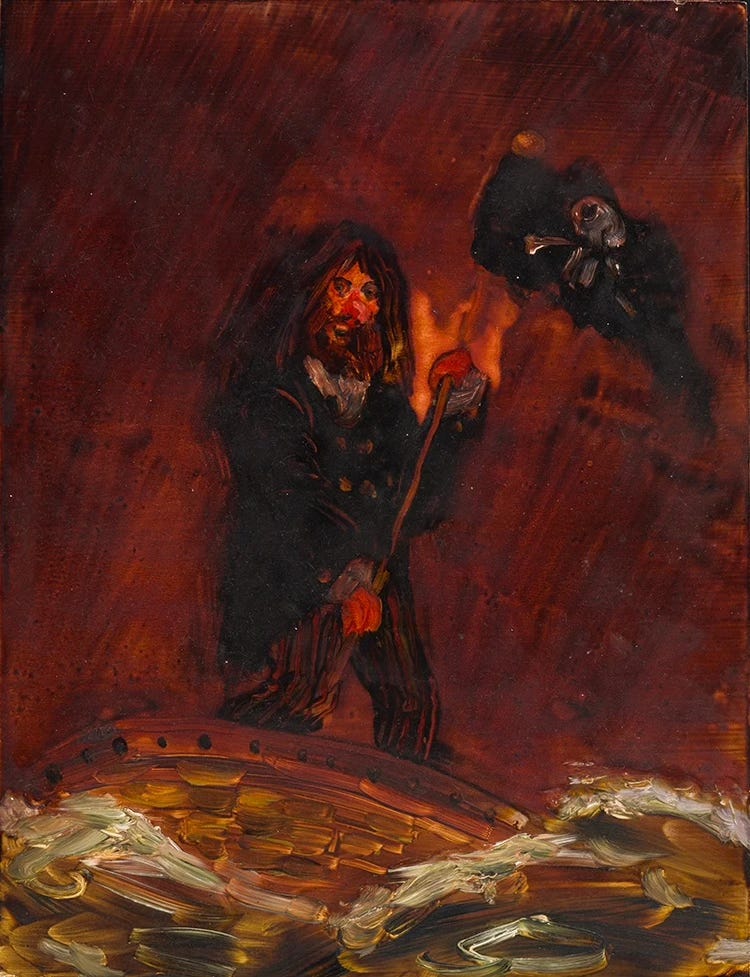
AE: Humor is a part of life, and I like humor in paintings. I think it’s very important. There are lots of ways things can be funny. I try to keep things ambiguous. I don’t like to have punchlines in my work. I don’t want them to be “solved” in that way. I think the comics page does that well every day in the newspaper and I don’t think Painting needs to compete with that. My whole enterprise is sort of funny to me. There is also melancholy and desperation in my work and if you think that’s funny, that’s on you. I take it all pretty seriously.
MPM: Being both a musician and a painter, it’s inevitable both practices go through their own periods of retreat and renewal, stepping away from one discipline while returning to the other. Do you feel it’s a healthy relationship? What are the pros and cons of maintaining two disciplines?
AE: I do think it’s healthy to go back and forth. There are periods where I don’t do either and I’m learning that that is also healthy or at least fine. Writing music and songs is solitary work for me but making records is collaborative and social. There is also a performance element that is full of the energy of other people. It’s different than painting which is so much time alone and in your own head. I think it’s healthy. I need both.
MPM: What would you say is the guiding principle in your work?
AE: I suppose I believe that the personal is the universal, and the more subjective the work, the more it can communicate, good or bad. I think, if you are not deeply embarrassed by your work, then it’s probably not doing anybody any good. I want to Paint my whole life. I want to know who I am through what I do. It’s what I’m looking for in other people’s work. I think that applies to everything I’m doing, not just painting and music. Is that a principle? Just kidding, I don’t have any principles, just behaviors.
"I don’t have any principles, just behaviors." Probably the most honest statement ever made 😆
some great quotes here on humor and being human. "If you are not embarrassed by your work you are not trying" lots of boundary transgression ! love this